Swimming
Swimming speed
The rate of locomotion of individual fish.
What the evidence says
Atlantic salmon are naturally active swimmers, with routine swimming speeds typically between 0.3 to 0.9 BL s⁻¹.
Absolute swimming capacity increases with fish size, while maximum speed relative to body length decreases with size.
Swimming capacity is reduced by amoebic gill disease, and likely other gill pathologies.
Maximum swimming capacity is strongly influenced by temperature, and reduced at both extreme low and high temperatures.
How to score the indicator
Scoring guidelines
- Manual swim speed estimation is done by measuring the time it takes for a fish to pass a fixed position from snout to caudal fin, typically in body lengths per second (BL s⁻¹).
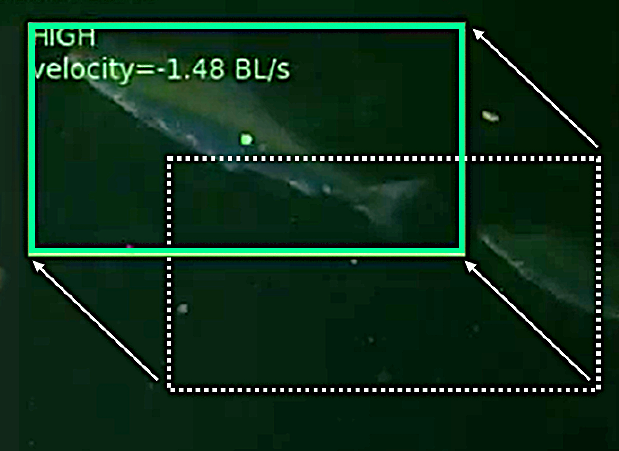
- Automatic swim speed assessment is done by tracking a fish’s movement between consecutive frames, and can be in either cm s⁻¹ or BL s⁻¹.
- Direction of movement relative to current direction and speed can confound swim speed estimates, especially with small sample sizes.
Classification examples
Interpretation
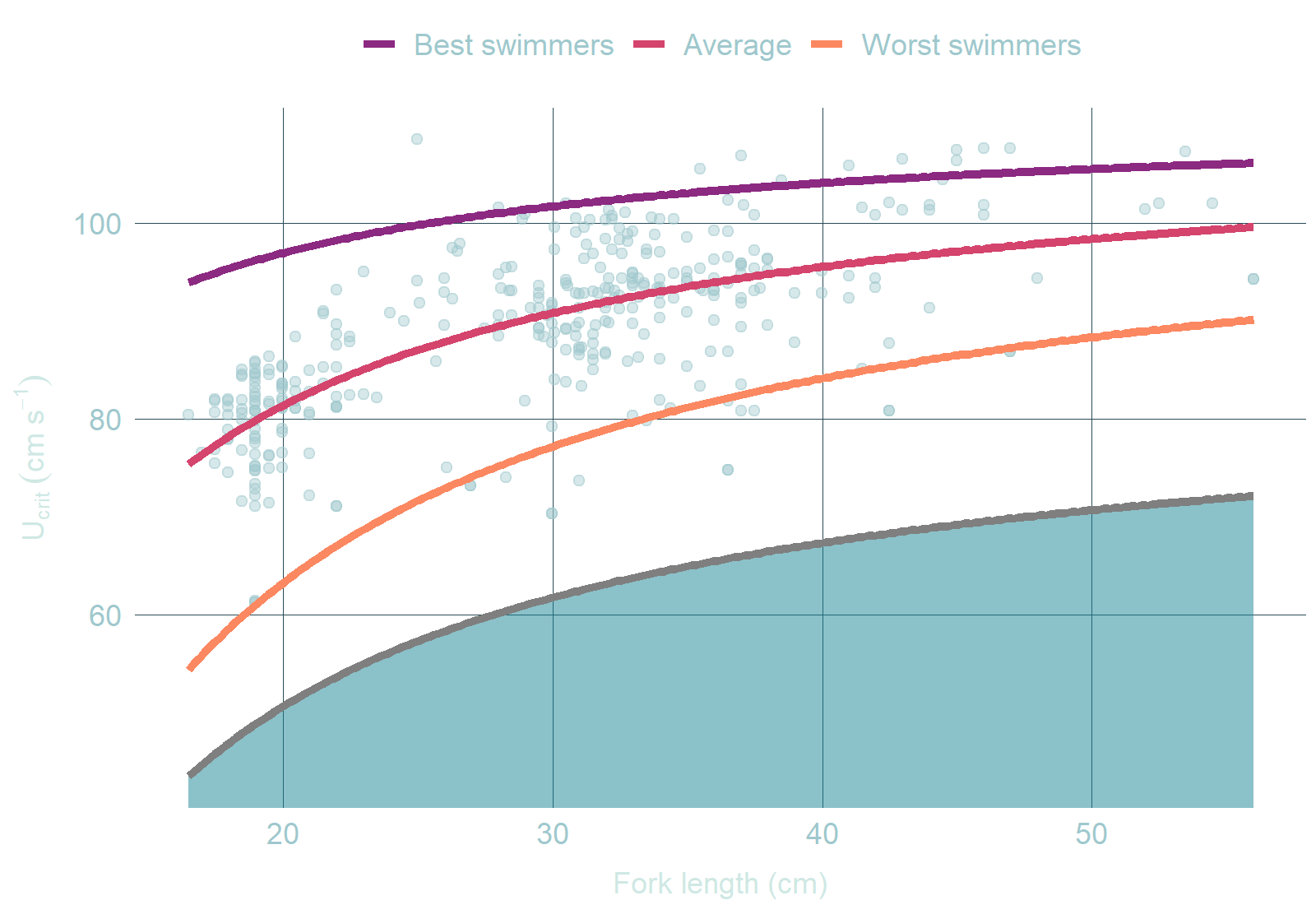
Maximum sustained swimming speed (≥ 4 hrs) is ~80% of critical swimming speed. This figure shows the critical swimming speed (Ucrit) of individual Atlantic salmon measured at ~13.5 °C. Regression lines indicate Ucrit of the best (magenta), average (pink) and worst (orange) swimmers. The turquoise line and shaded area indicate the 80% Ucrit level of the worst swimmers as a conservative estimate of sustained swimming capacity. Figure recreated from Hvas et al. (2021).
Modulating factors
Body size ▲ Increases capacity
Dissolved oxygen ▼ Decreases capacity
Temperature ◆ Condition dependent
What remains unknown
- Coming soon